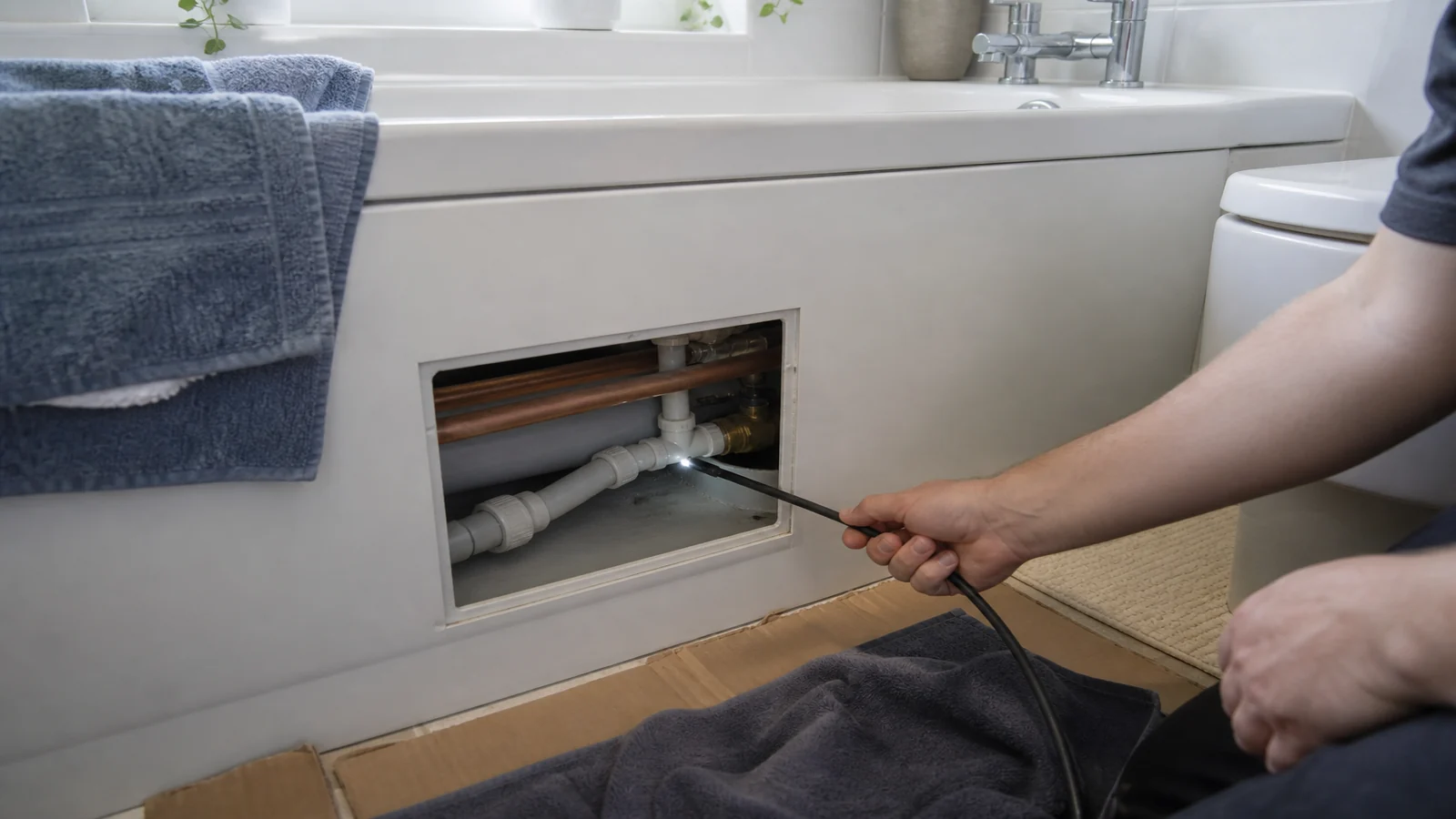
Inspection Camera Behind Bath Panel Leak: Find the Source Without Guesswork
An inspection camera behind a bath panel leak can show dry or wet pipe joints, a waste trap, and whether water is actively moving, provided the camera stays out of pooled water. It will not by itself tell you whether to claim on insurance or strip the room. Test taps, waste, sealant and supply in a fixed order, protect the floor, and isolate the water if the leak is uncontrolled.
Can an inspection camera locate a leak behind a bath panel?
It can locate some leaks and rule out others. A view of a weeping compression fitting, a split flexible connector, or a wet trap gasket is a clear next step for a plumber. A view of dry copper and a dry waste while the floor beyond the panel is wet points you to the shower, a neighbouring pipe, or water tracking from a failed seal. Prompt identification matters because leaks waste water and spread damage, as set out in WaterSafe advice on water leaks.
The camera only helps in a dry or barely damp void. Do not place a non-waterproof camera into pooled water. If the void is flooded, isolate the supply first and deal with standing water before any inspection tool goes in.
What should I test first: taps, waste, sealant or supply pipes?
Use this checklist and change only one variable at a time.
- Protect the floor with towels and a tray. Know where the bath isolating valves and the house stop tap are before you start.
- Look at the visible silicone and grout with the bath empty and dry. Failed sealant at the wall abutment is a common tracker of splash water, not a supply burst.
- Fill the bath, then empty it through the waste only, with taps off. Watch the panel opening or camera view during emptying. A wet waste or overflow points to drainage, not the rising main.
- Open the taps with the waste open and the bath empty. A wet tap tail, hose or connector that stayed dry during the waste test points to the supply.
- If both tests stay dry, run a nearby basin or shower that shares boxing. Tracking from next door is easy to miss.
- Only then use the camera through an existing service opening. Do not prise off a sealed panel in a rented bathroom until you know you are allowed to, and do not remove finishes that will make damage worse.
If water is running with all taps off, skip the checklist and isolate the supply.
Shared boxing is common in UK bathrooms: a bath panel that also hides the basin tails, a shower pump, or a toilet overflow. If the camera shows a dry bath trap but a wet pipe arriving from the basin side, stop opening the bath and test the basin waste next. If the wet line is a flexible hose with a crushed olive, that is a supply joint, not a sealant job. If the overflow standpipe is wet only after a deep fill, the overflow is discharging into the void and the bath is being overfilled or the overflow hose has slipped.
Tenants should photograph the sealed panel, report the leak, and wait for the landlord's plumber unless the tenancy already allows a screw-fixed access hatch. Owner-occupiers should still avoid ripping out a glued panel that is holding a cracked bath lip together. The aim is one small, reversible look, then a plumber with a named joint, not a gutted bathroom overnight.
How do I avoid making water damage worse?
Keep electricity out of the wet zone. Do not run mains power tools beside an open panel with water on the floor. Lift what you can off the boarding, and do not store the removed panel where it will trip someone carrying a bucket.
Escape-of-water damage can become extensive, and insurance conditions and mitigation duties may matter. Read the Association of British Insurers escape of water guidance for the insurance framing, then follow your own policy. Photograph the area before you open more of it. Do not strip a whole wall of tiles to chase a stain the camera has not yet explained.
What clues separate an active leak from old staining?
Active leaks are wet now: beads on a joint, a growing dark patch, a musty smell that returns after cleaning, or a meter that still moves when the house is not using water. Old staining is dry to the touch, does not grow after a controlled fill-and-empty test, and often matches a repair that already happened, such as a replaced trap.
Camera clues help only if you compare before and after a test. A joint that is dry, then wet after the taps run, is active. A brown mark that never glistens, with dry dust on it, is history. Do not confuse rust on a screw with a current burst.
When should I turn the water off and call a plumber?
Turn the water off and call a plumber when the leak is uncontrolled, when you cannot tell supply from waste, when water is near electrical fittings, or when the void is pooling. Isolate water for an uncontrolled supply leak even if you think you can see the joint; a camera still is not a repair.
If the leak only appears after a hot bath, feel whether the wet joint is on the hot tail. Heat can open a tired washer that stays dry on a cold-fill test. If the leak only appears after a shower on the other side of the same boxing, the bath panel is the viewing window, not the source. Write down which fixture was running when the camera first showed water, because that is the fact a plumber can act on.
Call a plumber, not a general builder, if the next action is to replace a connector, remake a waste, or test a hidden valve. Keep the camera record to show where you looked, including left-hand tap tail, overflow, and trap.
Who this inspection method is not for
This article is not for anyone facing pooled water around electrical fittings. This article is not for tenants who would have to remove a sealed panel against the tenancy. It is also the wrong method for a whole-house leak with a spinning meter and no local bathroom clue, and for a camera that would have to go underwater.
When the job should stop
Stop if the camera would enter pooled water. Stop if removing a sealed panel may worsen damage or affect a tenancy. Stop if the leak continues with all local taps off and you cannot isolate it quickly.
If the void is dry enough for a look through an existing opening, a slim inspection camera can save you from lifting the whole panel on guesswork. See the ARTICAM articulating inspection camera for a dry-use probe, and if the wet wall continues beyond the bathroom, use the wall inspection checks before drilling before you cut a new hole in the boxing.