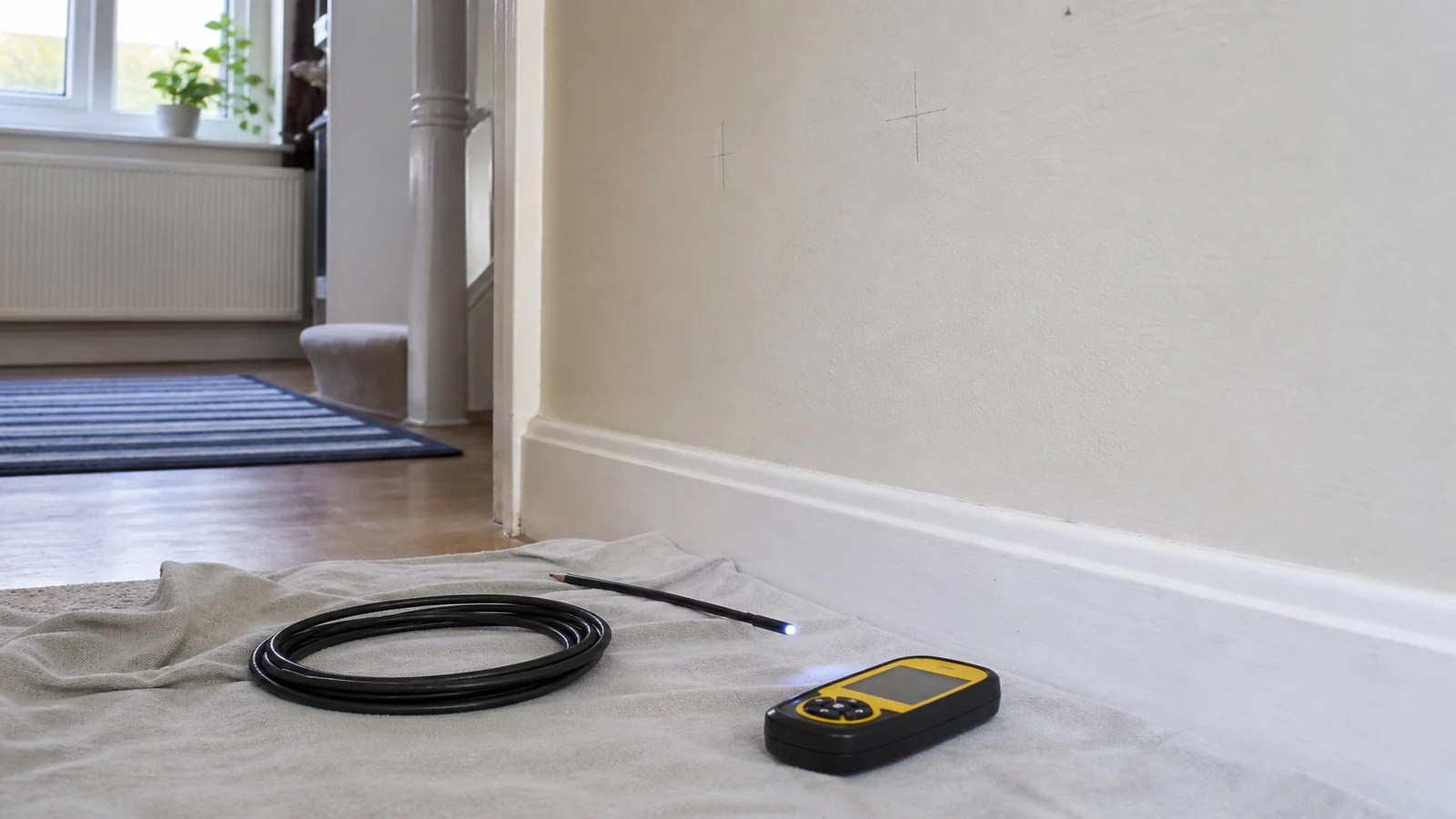
Inspection Camera Before Drilling Wall: A Safer UK Checklist
An inspection camera before drilling a wall can reduce uncertainty about what sits in a cavity, but it cannot make drilling safe on its own. A camera does not detect live electricity, and a picture of plasterboard, insulation or timber will not prove that a hidden board is free of asbestos. Use a visual check only after you have mapped likely cable and pipe routes, scanned the surface with a cable detector, and decided whether a small inspection hole is even justified.
Can an inspection camera make drilling into a wall safe?
No. Safety comes from a sequence of checks, not from a single gadget. Electrical Safety First's advice for DIY-ers is to locate buried cables, avoid drilling close to hidden wiring, switch the power off at the fuseboard for work near electrics, and leave electrical work to a registered competent person. Read that Electrical Safety First DIY electrical safety guidance before you pick up a drill.
A slim probe can show whether a cavity is empty, packed with insulation, or occupied by a pipe, a back box, or a timber stud. It cannot tell you whether a cable is live, whether a metal pipe is gas or water, or whether a textured coating is an asbestos-containing material. Treat every encouraging image as one input, not a permit to drill.
What should I check before making an access hole?
Work through this checklist in order. Skip a step only when you already have a better source of information, such as original drawings or a tradesperson who has opened the same wall.
- Confirm why you need a hole. A 6 mm fixing for a picture hook is a different risk from a 32 mm hole for a cable or a waste pipe.
- Photograph the room, then mark the intended point in pencil. Note sockets, switches, fused spurs, radiators, and the other side of a partition if you can reach it.
- Assume cables run horizontally or vertically from those accessories, and also near the top of the wall and internal corners, unless you have proof they do not.
- Switch the circuit off at the consumer unit for any work that could reach wiring, then prove a nearby socket or light is dead.
- Scan the area slowly with a cable and metal detector in both directions. Mark every hit, including faint ones.
- Check the wall type: solid masonry, plasterboard on studs, or a hybrid. A camera is most useful in a true cavity, not in a solid brick wall with only a few millimetres of plaster.
- Ask whether the finish could contain asbestos, especially in houses built or refurbished before the 1980s: textured coatings, old insulating board, vinyl floor tiles above a skirting chase, and some cement products. If you cannot rule that out, do not drill.
- Only then consider a small inspection hole in a location that is already the intended fixing point, not a random extra puncture.
If you still cannot place the hole away from detector hits and predicted cable routes, do not create an inspection opening. Call a registered electrician or plumber instead.
Keep the inspection hole no larger than the fixing you already need. A second exploratory puncture in a different place doubles the chance of meeting a cable that the first scan only just missed. If the camera view is a wall of insulation, accept that limit and move the fixing, rather than digging a trench across the board with the probe.
How do cables, pipes and insulation change the decision?
Cables change the decision immediately. A detector hit in line with a socket, or a camera view of a grey or white sheath, is a stop for DIY drilling. Insulation changes the decision more quietly: mineral wool can hide a pipe or a cable just beyond the first few centimetres, and foil-faced products can confuse a cheap detector. Pipes change the decision when you see copper, plastic barrier pipe, or a soldered fitting. Water damage and a gas leak are both worse than moving a shelf a few centimetres.
A packed cavity also limits what a small camera can show. If the void is full, the probe may only report insulation colour and texture. That is still useful: it tells you not to assume an empty gap. It is not useful as proof that the far side is clear at fixing depth.
What can a camera show that a cable detector cannot?
A detector infers metal and, on some models, live conductors. A camera shows shape, colour, joints and empty space. Typical helpful views include the edge of a timber stud, the back of a socket box, a drip stain on the paper face of plasterboard, a pipe clip, or a clear run that matches where you hoped to drill. Typical unhelpful views include a blur of dust, a wall of insulation, or a dark void with no scale.
Use both tools. The detector tells you where not to open. The camera, used only after that scan, tells you whether the cavity at that one point looks empty enough for the depth you need. Neither tool replaces the other.
When should I stop and call an electrician or plumber?
Stop if the wall route or service location remains uncertain. Stop if you suspect asbestos-containing material. The Health and Safety Executive is clear that disturbing asbestos-containing materials can release fibres; do not drill or cut suspect material as a casual DIY step. Follow the HSE asbestos frequently asked questions and get competent advice rather than pushing on.
Call a registered electrician if a detector keeps alarming, if you see a cable, if a circuit trips, or if the job is in a bathroom zone or involves a new circuit. Call a plumber if you see a pipe, hear water, or the wall is below a bathroom or beside a radiator. Call both if the wall carries mixed services, which is common in UK kitchens and utility rooms.
Who this inspection method is not for
This article is not for anyone who already knows there is live wiring in the intended drill path. This article is not for licensed asbestos removal or electrical installation work. It is also a poor fit if you need to chase a whole cable route, install a consumer unit, or prove a wall's fire or acoustic build-up. Those jobs need drawings, a competent trade, or both.
When the job should stop
Keep the drill in the bag when any of these stop conditions appear: the detector and the camera disagree; you cannot isolate the circuit; the finish might contain asbestos; you are drilling a wall thinner than 100 mm with accessories on the far side; or you would have to force the probe. Stop if the wall route or service location remains uncertain, even if the camera image looks empty in the first few centimetres.
If a dry look into a cavity is still the right next step after those checks, a slim articulating inspection camera is the sort of tool used for this work. See the ARTICAM articulating inspection camera for a dry-use option, and compare that with a bath panel leak inspection if the wall you are about to drill is a boxed-in bathroom void rather than a simple partition.