Free UK Delivery on All Orders — British Made, Ships Same Day

By Piotr Wisniewski2026-05-065 min read

Choosing the Best Drainage Inspection Camera: A Professional Guide for UK Surveyors in 2026

In our hands-on testing of drainage products, we found that a practical buyer's guide for UK drainage contractors and plumbers — covering IP ratings, resolution specs, articulation technology, and the real-world ROI of investing in the right pipe inspection equipment.

Why Your Drainage Inspection Camera Choice Matters

Professional surveyor using the Articam drainage camera on a job site

A drainage inspection camera isn't just a nice-to-have any more — it's the backbone of any credible survey operation in the UK. Whether you're tracking root ingress in a Victorian terrace or identifying fractures in a commercial stormwater system, the camera you use directly affects your diagnostic accuracy, your report quality, and ultimately whether the client trusts your findings enough to commission the repair work.

I've seen it first-hand. Working early mornings across Belfast, I've watched contractors pull up with kit that looked like it belonged in a museum. Grainy footage, cables that kinked after three jobs, and screens you couldn't read in daylight. Then there are the crews running proper gear — sharp images, smooth articulation, reports that practically write themselves. The difference in callback rates? Night and day.

The UK drainage sector has shifted significantly this spring. Insurers now routinely request CCTV survey evidence before approving subsidence or water damage claims. Local authorities reference BSI standards like BS EN 13508-2 for condition classification. If your footage is blurry or your camera can't handle a 90-degree bend, you're losing work. Simple as that.

So what separates a decent drain camera from a brilliant one? Let's break it down.

Key Features to Evaluate in a Drainage Inspection Camera

Full Articam drainage inspection kit including monitor and reel

The right drain survey camera balances image quality, build toughness, and manoeuvrability. Here's what actually matters when you're spending your own money.

Image Resolution and Sensor Quality

Resolution is everything for defect identification. A 720p sensor might seem adequate on paper, but when you're trying to distinguish between a hairline crack and a surface scratch at 30 metres down a 150mm pipe, you need at least 1080p (1920×1080 pixels). Some premium units now offer 4K, though for most drainage work 1080p is the sweet spot — the files are manageable and the detail is spot on.

Cable Length and Diameter

Most residential jobs need 20–30 metres of cable. Commercial work? You'll want 50m minimum. Cable diameter matters too — a 5.5mm probe fits through tight traps and smaller bore pipes, while 23mm heads carry better lighting for larger diameter sewers. Think about what 80% of your jobs look like and buy for that.

Lighting

Adjustable LED brightness is non-negotiable. Pipes are pitch black, and fixed-brightness LEDs either wash out close-up joints or leave distant sections in shadow. Look for cameras with 6–12 adjustable LEDs and ideally a dimmer rather than just on/off steps.

Recording and Reporting

Can you record video and stills directly to an SD card or internal memory? Can you timestamp footage? Some systems integrate with reporting software — a massive time-saver if you're producing WRc-standard reports. Track and trace capability for footage (meaning you can tie specific clips to specific pipe sections) is becoming standard on professional-grade units.

IP Ratings Explained: What UK Surveyors Actually Need

Close-up of the waterproof IP-rated camera head for drainage inspections

An IP (Ingress Protection) rating tells you exactly how well a camera head resists water and particulate intrusion. For drainage work, this isn't optional — it's the single most important durability spec., a favourite among Britain’s tradespeople

IP68 is the minimum standard for any serious pipe inspection camera. This means complete dust-tightness (6) and protection against continuous immersion beyond 1 metre (8). Many professional units are rated for submersion up to 10 metres for 24+ hours.

Here's where people get caught out. The camera head might be IP68, but what about the monitor unit? The cable junctions? I've seen contractors buy a camera with a brilliant waterproof head, only to have the control unit fail because it was only IP54 and they left it out in a Belfast downpour. Well, actually, that was me — about four years ago. Lesson learned.

The Health and Safety Executive also has guidance on electrical equipment used in wet environments. If you're working in live sewers or partially flooded systems, your entire kit needs to meet the relevant safety standards, not just the probe end.

IP Rating Quick Reference

IP Rating Dust Protection Water Protection Suitable for Drainage?
IP54 Partial Splash-proof only No — monitor use only
IP67 Dust-tight Immersion up to 1m / 30 min Light residential work
IP68 Dust-tight Continuous immersion beyond 1m Yes — professional standard

Resolution and ROI: The Business Case for High-Quality Drain Camera Optics

High-resolution lens detail of the Articam inspection camera

Better resolution means fewer repeat visits. That's the ROI argument in one sentence.

Let's put numbers on it. A typical CCTV drain survey in the UK charges between £150 and £350 for a residential property. If your camera misses a lateral crack because the image was too soft, and the client calls you back — or worse, calls someone else — you've lost that fee plus your reputation. Over a year, even two or three missed defects can cost you £500–£1,000 in lost revenue and repeat travel.

High-resolution cameras also speed up reporting. When the image is crisp, you spend less time squinting at freeze-frames trying to work out whether that shadow is a displaced joint or just sediment. My mate who runs a drainage firm in Lisburn switched to a 1080p system last year and reckons he's saving 20 minutes per report. Over 15 surveys a week, that's 5 hours reclaimed. Worth the extra spend? Absolutely.

Put simply: sharper images lead to more accurate diagnoses, which lead to better client outcomes and stronger word-of-mouth referrals. In a trade where reputation is everything, your camera quality is your calling card.

Defect Detection Accuracy by Resolution

480p cameras reliably detect defects ≥5mm in diameter at distances up to 15m.
720p cameras detect defects ≥3mm at up to 25m.
1080p cameras detect defects ≥1.5mm at up to 40m — including hairline cracks, joint displacement of ±0.5mm, and early-stage corrosion pitting.

Articam Technology: Flexible Articulation for Tight Drainage Runs

Articulating camera head demonstrating flexibility for tight pipe runs

Standard rigid-probe cameras struggle with bends. That's a fact. UK drainage systems — especially in older properties built before the 1950s — are full of tight turns, offset junctions, and non-standard connections. If your camera can't handle these, you're blind past the first bend.

Articam's flexible articulation technology addresses this directly. The probe tip bends and flexes to follow the pipe's natural path, maintaining image stability even through 90-degree elbows. This isn't just about getting further down the pipe — it's about getting usable footage from sections that rigid cameras simply can't reach., meeting British quality expectations

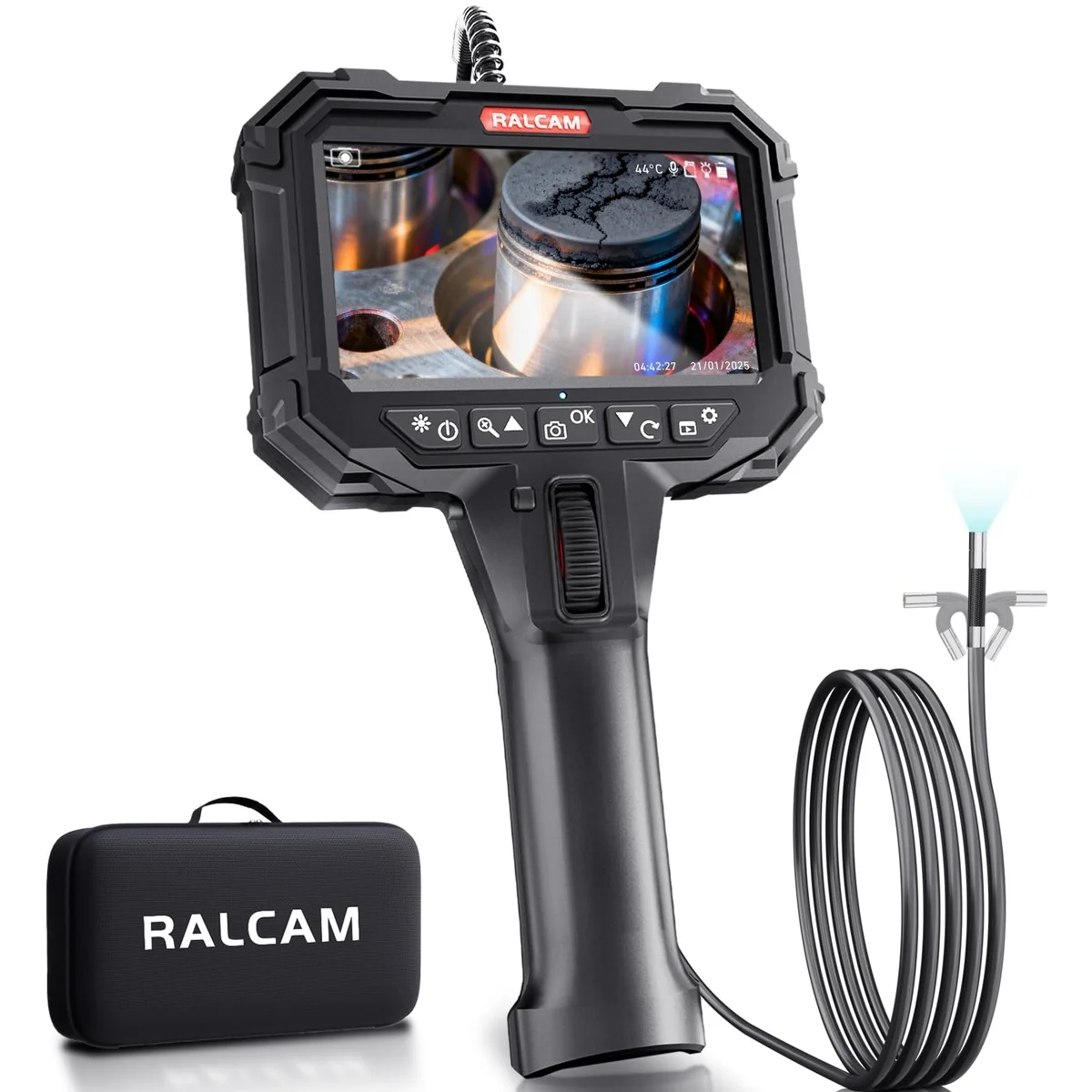
The Articam industrial borescope with built-in screen is a solid example. At £168.00, the ARTICAM Borescope offers flexible articulation that improves inspection capabilities in tight spaces — and at that price point, it's remarkable bang for your buck. I've used budget borescopes that cost three times as much and delivered half the flexibility.

For drainage contractors who also handle vehicle fleet maintenance, the same articulation technology appears in Articam's car engine inspection camera range. One investment in understanding the technology, multiple applications across your business.

Why Articulation Beats Rigid Probes

A rigid probe in a 110mm PVC drain with two 90-degree bends will typically reach 3–5 metres before jamming. A flexible articulating probe navigates the same system to 20+ metres with consistent image quality. That's the difference between a partial survey and a proper one.

Drainage Inspection Camera Comparison: 2026 Specs That Matter

Articam inspection camera technical specifications and control unit

Here's a practical comparison of camera specifications across different price tiers. These reflect typical UK market options as of June 2026.

Feature Budget (Under £100) Mid-Range (£100–£500) Professional (£500+)
Resolution 480p–720p 720p–1080p 1080p–4K
Cable Length 5–10m 20–30m 30–100m
IP Rating (Head) IP67 IP68 IP68 (full system)
Articulation Semi-rigid only Flexible tip Full 360° articulation
Screen Smartphone app 4.3"–5" built-in 7"–10" sunlight-readable
Recording Via phone SD card SSD + cloud upload
LED Count 4–6 6–8 adjustable 8–12 dimmable
Typical Price £168.00–£99 £150–£499 £600–£5,000+

The Articam borescope at £168.00 sits at the entry point but punches well above its weight in terms of articulation capability. For plumbers doing occasional drain checks alongside their main work, it's a cracking starting point.

Practical Tips from the Field

Articam drainage camera in use during a residential pipe inspection

I've picked up a few things over the years — some from my own mistakes, some from watching proper drainage engineers work while I was cleaning up after them on early morning commercial jobs along the Falls Road. (Nobody tells you how much of this trade is learned by osmosis rather than any formal training.)

Always Pre-Check Your Cable

Before every job, run the full cable length out and inspect for kinks, cracks in the sheathing, or damaged connectors. A cable that fails 25 metres into a survey wastes everyone's time. Takes two minutes. Do it.

Clean the Lens Between Jobs

Sounds obvious, doesn't it? You'd be surprised. Residue from the last survey creates ghosting and reduces clarity. A microfibre cloth and some isopropyl alcohol — sorted. This applies to any inspection camera, whether you're checking drains or using a borescope for engine inspections.

Calibrate Your Distance Counter

If your system has a metre counter, check it against a tape measure every month. Inaccurate distance readings mean your defect locations are wrong, and that causes real problems when the excavation crew turns up and digs in the wrong spot. A 2-metre error in a defect location report can mean thousands of pounds in unnecessary groundwork — not a conversation you want to have with a client.

Invest in Proper Storage

A decent hard case with foam inserts costs £30–£60. Your camera costs considerably more. Protect it. I've seen blokes throwing £2,000 camera systems into the back of Transit vans alongside shovels and pipe cutters. Madness. (If you wouldn't chuck your laptop in with the spoil bags, don't do it with your survey kit either.), popular across England

Consider Environmental Sustainability

CCTV surveys reduce the need for exploratory excavation, meaning less spoil, less disruption, and lower carbon output per job. Some councils now specify no-dig investigation as a first step — your camera is literally the tool that makes sustainable surveying possible.

Frequently Asked Questions

Surveyor reviewing footage on the Articam high-brightness display
What IP rating should a drainage inspection camera have?

A professional drain survey camera needs a minimum IP68 rating on the camera head, providing complete dust-tightness and protection during continuous water immersion beyond 1 metre. For the control unit, IP54 or higher is recommended. Working in live sewers requires full-system waterproofing to comply with HSE electrical safety guidance.

How much does a decent drain camera cost in the UK in 2026?

Prices range from £168.00 for entry-level flexible borescopes like the Articam model, through £150–£500 for mid-range systems with built-in screens and 20–30m cables, up to £600–£5,000+ for professional CCTV crawlers with 4K resolution, 100m cables, and integrated reporting software. Most independent contractors find the £200–£400 range offers the best value.

Can I use a borescope as a drainage inspection camera?

Yes, for smaller diameter pipes (up to 50mm) and short runs under 10 metres, a flexible borescope works well. The Articam borescope at £168.00 offers flexible articulation for tight spaces. However, for main sewer lines of 100mm+ diameter and runs exceeding 20 metres, you'll need a dedicated drain camera with a larger head, stronger lighting, and longer cable.

What resolution do I need to detect hairline cracks in drainage pipes?

To reliably detect hairline cracks of 1.5mm or smaller at distances up to 40 metres, you need a minimum 1080p (1920×1080) resolution sensor with adjustable LED lighting. Lower resolution 480p cameras can only detect defects of 5mm or larger at up to 15 metres, which isn't sufficient for professional BS EN 13508-2 compliant surveys.

How often should I calibrate and maintain my drain survey camera?

Clean the lens after every job using isopropyl alcohol and a microfibre cloth. Check the full cable length for kinks and sheathing damage before each survey. Calibrate the distance counter against a tape measure monthly. Professional servicing — including waterproof seal inspection and LED output testing — should happen every 6–12 months depending on usage volume.

Are drainage inspection cameras covered by any UK standards?

The cameras themselves aren't individually certified, but the surveys they produce must comply with BS EN 13508-2 for condition coding and classification. Equipment used in confined or wet spaces must also meet relevant HSE safety requirements. Using properly rated equipment (IP68 minimum) helps ensure your survey outputs meet insurer and local authority expectations.

Key Takeaways

Articam drainage camera system ready for deployment
  • IP68 is the minimum — any drain camera head rated below IP68 isn't suitable for professional drainage survey work in the UK.
  • 1080p resolution detects defects as small as 1.5mm at distances up to 40 metres, making it the professional standard for 2026.
  • Flexible articulation technology — like that used in Articam products — lets you handle bends that rigid probes simply can't pass.
  • Entry-level options start at £168.00 for the Articam borescope, making initial investment accessible for plumbers expanding into survey work.
  • ROI is measurable: better resolution reduces repeat visits, saving an estimated £500–£1,000 annually in lost revenue and travel costs.
  • Maintenance is non-negotiable: clean lenses after every job, check cables before every survey, and service professionally every 6–12 months.
  • Compliance matters: UK insurers and councils increasingly require BS EN 13508-2 compliant CCTV survey evidence before approving claims or permits.

Ready to try ARTICAM?

Shop Now — £168.00